


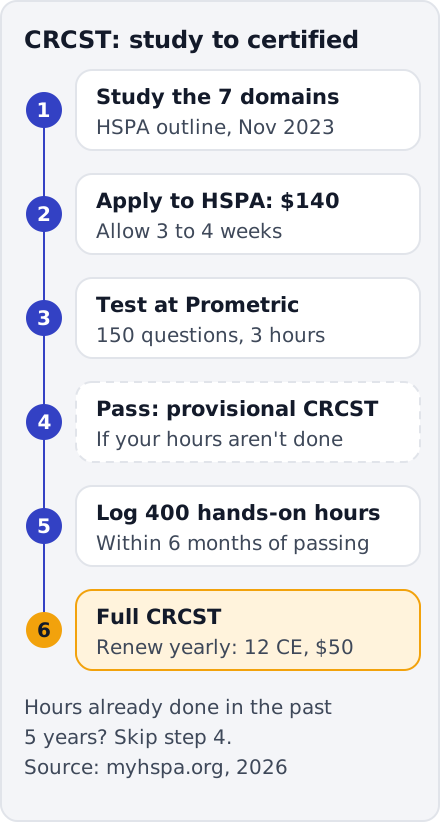
To become a sterile processing technician, learn the work through a course or on the job, log 400 hands-on hours in a hospital sterile processing department, and pass a certification exam such as HSPA's CRCST. BLS lists a high school diploma or equivalent as the typical entry education (BLS). HSPA lets you take the exam before your hours are done, so the two can overlap.
What a sterile processing technician does
Sterile processing techs clean, inspect, package and sterilize the reusable instruments and equipment used in surgery and patient care. Every surgical tray in a hospital goes through the sterile processing department between patients. The work follows a fixed loop:
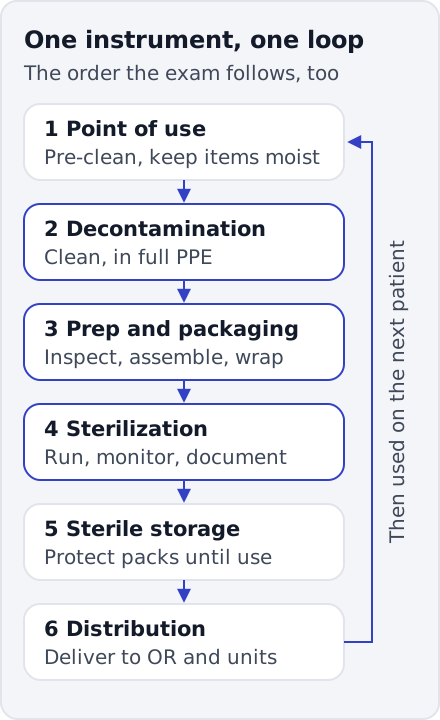
- Decontamination: cleaning used instruments by hand and in washers, wearing full protective equipment.
- Preparation and packaging: inspecting each instrument, testing that it works, building trays from count sheets and wrapping them.
- Sterilization: loading and running steam and low-temperature sterilizers, and checking the tests that prove each cycle worked.
- Storage and distribution: keeping sterile items protected and getting them to the operating room and units on time.
The job is hands-on and exacting. One missed step can put a patient at risk. Other names for the same job include central service technician, central sterile supply tech and SPD tech. The US Bureau of Labor Statistics groups it as "medical equipment preparers."
Step 1: Learn the basics
You have two main options.
A training course. Community colleges, technical schools and online programs offer sterile processing courses. Some include a hospital rotation, which also gives you hands-on hours. Ask whether a program includes that rotation and which exam it prepares you for.
On-the-job training. Some hospitals hire entry-level aides or trainees and teach them in the department. You are paid while you learn, and your hours count toward certification.
HSPA says a course is not required to take the CRCST (HSPA). Our sterile processing technician training page compares programs and published prices.
Step 2: Get 400 hands-on hours
The CRCST needs 400 hours of hands-on work in a sterile processing department, paid or volunteer. HSPA sets minimums for each area: 120 hours each in decontamination, preparation and packaging, and sterilization and disinfection, 24 in storage and distribution, and 16 in quality assurance.
You can finish the hours before the exam, or pass first and finish them within six months as a provisional CRCST. See our CRCST 400 hours guide for who can sign them and what happens if you miss the deadline.
Step 3: Pass a certification exam
The two main technician exams in the US are:
- CRCST from HSPA: 150 multiple-choice questions in 3 hours at a Prometric testing center, $140.
- CSPDT from CBSPD: 150 questions, including 25 unscored pretest questions, $135.
Our CRCST vs CBSPD comparison explains the differences in eligibility and renewal, and the CRCST exam page covers scheduling and results. Check job posts in your area to see which one employers name.
Most CRCST questions are short work scenarios. Two free examples from our bank:
1. Which sequence shows the correct one-way flow of instruments through the department?
- A. Prep and packaging, decontamination, sterilization, sterile storage
- B. Decontamination, sterile storage, prep and packaging, sterilization
- C. Sterilization, decontamination, prep and packaging, sterile storage
- D. Decontamination, prep and packaging, sterilization, sterile storage
Answer: D. Instruments move one way, from dirty to clean to sterile, so contaminated items never cross paths with clean ones. It is the same loop as the diagram above.
2. When should the Bowie-Dick test be run on a prevacuum steam sterilizer?
- A. Each day, in the last load of the day along with other packs
- B. Once a week, in a chamber that is fully loaded
- C. Daily, in an empty chamber, in the first cycle after warm-up
- D. Only after a biological indicator has come back positive
Answer: C. The Bowie-Dick test checks that the sterilizer removes air so steam reaches the center of a pack. It runs each day before the first patient load, alone in the chamber. Our Bowie-Dick test page shows how to read the sheet.
The free 25-question diagnostic uses questions like these and scores you in each of HSPA's seven domains. Then use the study guides for your lowest domains. The how to pass the CRCST page has a six-week study plan.
Step 4: Apply for jobs and keep your certification
With a certification, you can apply for technician roles in hospitals, surgery centers and clinics. Some employers hire uncertified techs and set a deadline to certify. Seven states set that deadline by law, from 18 months to three years after hire; see sterile processing technician certification.
A CRCST is renewed every year with 12 CE credits and a $50 fee. See CRCST renewal for what counts as CE.
What sterile processing technicians earn
BLS publishes wage data for medical equipment preparers, the federal job category that includes sterile processing techs. In the May 2025 data:
| Measure | Annual wage |
|---|---|
| 10th percentile | $36,410 |
| Median | $47,700 |
| Mean | $50,510 |
| 90th percentile | $69,950 |
Pay varies a lot by state. In the same data, California had the highest mean wage at $65,100. These figures are for all medical equipment preparers, certified or not. BLS does not publish a separate figure for CRCST holders. Our CRCST salary page goes into more detail.
How long it takes
HSPA sets no fixed timeline. The parts that have a published length:
| Part | Time | Source |
|---|---|---|
| A course, if you take one | Set by the school; Dallas College lists about 4 months full time | Training page |
| 400 hands-on hours | 10 weeks at 40 hours a week; 25 weeks at 16 | Our arithmetic from HSPA's 400 hours |
| HSPA application processing | 3 to 4 weeks | HSPA handbook |
| Window to take the exam after approval | 120 days | HSPA handbook |
| Hours due after passing, if provisional | 6 months, plus one possible 2-month extension | HSPA |
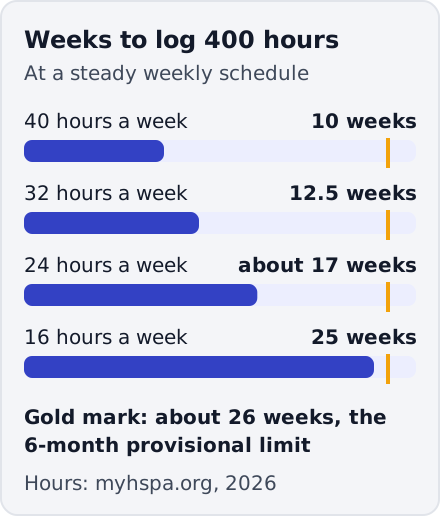
Study time depends on you, and HSPA doesn't suggest one. Because you can apply and test while you log hours, a full-time trainee's hours and application can run at the same time.
Frequently asked questions
Do you need a degree to be a sterile processing technician?
No. BLS lists a high school diploma or equivalent as the typical entry education. For the CRCST, HSPA asks for 400 hands-on hours and a passing exam score. It doesn't require a degree, and a training course is optional.
How long does it take to become a sterile processing tech?
The longest fixed part is the 400 hands-on hours, which take 10 weeks at 40 hours a week. HSPA's application takes 3 to 4 weeks to process and can run at the same time, since you may test before your hours are done. Add any course and your own study time.
Can I become a sterile processing tech with no experience?
Yes. No healthcare background is required. You can take a course, or find an entry-level job or volunteer role in a sterile processing department and learn there. HSPA lets you take the CRCST before finishing your hours, as long as you complete them within six months.
Is sterile processing a good job?
It is steady hospital work with clear certification steps, and it can lead to lead tech, educator or supervisor roles. It is also physically demanding, and mistakes matter. BLS data for May 2025 put the median annual wage for medical equipment preparers at $47,700.
Which certification should I get first?
Check job posts where you want to work. The CRCST from HSPA and the CSPDT from CBSPD are both widely used technician certifications, and many posts accept either.
We are not affiliated with HSPA and never see real exam questions. Every question is written from HSPA's public content outline and the standards it names, so nothing here is a leaked or recalled item. How we write questions
Questions? support@crcstready.com