


To pass the CRCST, study the three big domains first (cleaning and decontamination, preparation and packaging, and sterilization, about 21% of the exam each), learn the reason behind each rule, and test yourself with explained practice questions every week. Most of the exam is short work scenarios, so knowing why a step exists matters more than memorizing lists.
Know what you are studying for
The CRCST is 150 multiple-choice questions in three hours, taken on a computer at a Prometric testing center (HSPA). HSPA's 2023 content outline divides it into seven domains:
| Domain | Share of exam |
|---|---|
| Cleaning, Decontamination and Disinfection | 21% |
| Preparation and Packaging | 21% |
| Sterilization Process | 21% |
| Departmental Considerations | 15% |
| Sterile Storage, Transport and Inventory Management | 9% |
| Professional Development and Human Relation Skills | 8% |
| Patient Care Equipment and Distribution | 5% |
HSPA says every question can be referenced to its Sterile Processing Technical Manual (9th edition, 2023), ANSI/AAMI ST79 or AORN's guidelines (HSPA manual page). You do not need to buy all three. The manual is the main book. The standards are where many manual rules come from.
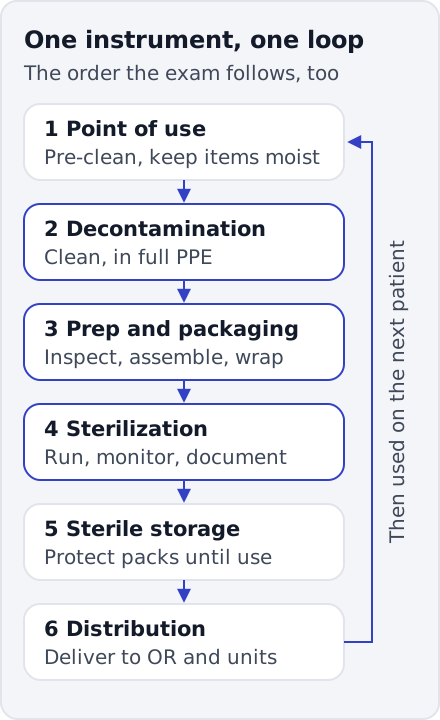
Study in the order instruments move
The exam domains follow the path a tray takes through the department. If you study in that order, each topic explains the next one. For example, you learn why a tray must be dry before you learn what a wet pack means at the sterilizer.
A six-week CRCST study plan
This plan assumes about one hour a day on workdays and a longer session on the weekend. If you already work in sterile processing, you may need less time on the areas you do every day. If you are new, add a week to the big three domains.
| Week | Study | Check yourself |
|---|---|---|
| 1 | Take the free diagnostic cold. Read the departmental considerations guide: air flow, temperature, humidity, dress code, regulations | Departmental practice questions |
| 2 | Cleaning and decontamination: PPE, manual and mechanical cleaning, water quality, Spaulding levels | Cleaning practice questions |
| 3 | Preparation and packaging: inspection, instrument names, set assembly, wrapping, indicators | Prep and packaging questions |
| 4 | Sterilization process: cycles, Bowie-Dick, biological indicators, implants, recalls | Sterilization questions |
| 5 | Storage, patient care equipment and professional development guides | The three smaller domains |
| 6 | Review your weakest domain again. Take full-length timed practice | Aim for steady scores across several tests |
Keep a short list of every question you got wrong and why. Read that list again at the end of each week. It will be more useful than rereading a whole chapter.
Topics that come up again and again
These are the areas where small details change the answer. Each one is covered in the linked guide.
- Sterilizer testing: what a Bowie-Dick test checks compared with a biological indicator, and when each is run. See Bowie-Dick test vs biological indicator.
- Spaulding classification: the item's contact with the body decides the process. Questions rarely use the words "critical" or "semi-critical." You have to work it out.
- Steam exposure times: gravity and dynamic air removal cycles at 250, 270 and 275 F.
- PPE: what to wear in decontamination, and the order to put it on and take it off.
- Implants: when an implant load can be released, and what early release requires.
- Event-related shelf life: a pack stays sterile until an event such as moisture, a tear or a drop compromises it.
- Instructions for use (IFU): when the IFU and a general rule disagree, the IFU usually wins. Many questions turn on this.
- Chemical indicator classes: what each class shows, and what none of them prove.
How to read CRCST questions
Many questions use words like first, best, most appropriate or except. Read the last line of the question before the scenario, so you know what you are looking for. Then read the scenario and cross out choices that are true but don't answer what was asked.
When two answers both look right, ask which one protects the patient. Sterile processing rules exist to prevent infection, so the safer choice is very often the correct one. For example, a wet pack is treated as contaminated, even if it "looks fine."
If English is not your first language, slow down on negative words like not, never and except. They flip the meaning of the question. Marking a question and returning to it later is allowed.
Exam day
- Arrive early with the ID Prometric asks for in your confirmation.
- A 15-minute tutorial runs before the test, and it is also available online, so you can see the screens in advance (HSPA).
- You have 180 minutes for 150 questions, about 72 seconds each. Answer every question. Mark the slow ones and come back.
- You can change answers before you submit. Change one only if you find a clear reason in the question.
If you don't pass
You can retake the exam after a wait of at least six weeks. HSPA's handbook says you can send the retake application and $140 fee as soon as you like, but your new eligibility starts six weeks after your last exam date. If you passed with provisional status and then miss your 400-hour deadline, HSPA says you lose provisional status and must retake the exam. Use your score report to see which domains pulled your score down, and study those first. The 400-hours guide explains the deadline.
Frequently asked questions
How long should I study for the CRCST?
It depends on your experience. HSPA does not recommend a study length. The plan on this page is six weeks at about an hour a day. If you already work in a sterile processing department, you may need less. Take the free diagnostic first so you can see how much ground you need to cover.
Is the CRCST exam hard?
It is a three-hour, 150-question exam, and many questions are short work scenarios. HSPA publishes yearly counts: in 2025, 10,083 of 15,369 CRCST candidates passed, about 66% (HSPA certification statistics). Candidates who understand why each rule exists, and who have practiced with explained questions, are in a better position than those who only memorized flashcards.
Do I need to take a course to pass the CRCST?
No. HSPA says you do not have to take or pass a preparatory course, or buy study materials, to sit the exam. A course can help if you study better with structure, but it is not required.
What book should I use?
HSPA's Sterile Processing Technical Manual, 9th edition (2023), is the main book. HSPA says every exam question can be referenced to that manual, ANSI/AAMI ST79 or AORN's guidelines. Make sure any practice questions you use were written for the 9th edition.
What is the passing score for the CRCST?
HSPA does not publish a passing score. On our mock exams, we treat 70% as ready. That is our own benchmark, and HSPA does not set it.
How many times can I take the CRCST exam?
HSPA's handbook does not list a maximum number of attempts. After a failed attempt you must wait at least six weeks before you can test again, and each retake costs $140.
Sources
Our Sterilization Process questions cite these documents, by document and, where we can confirm it, chapter or section.
- HSPA Sterile Processing Technical Manual (61 questions)
- ANSI/AAMI ST79 (34 questions)
- ANSI/AAMI ST41 (5 questions)
- OSHA 29 CFR 1910.1047 (2 questions)
- ANSI/AAMI ST58 (1 question)
We are not affiliated with HSPA and never see real exam questions. Every question is written from HSPA's public content outline and the standards it names, so nothing here is a leaked or recalled item. How we write questions
Questions? support@crcstready.com