


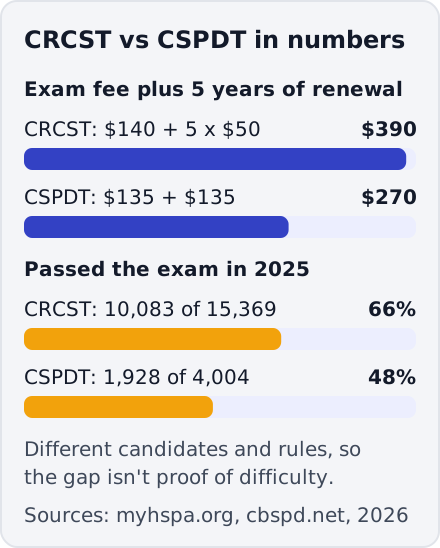
Choose the CRCST if you can get into a hospital sterile processing department, and the CBSPD technician credential (CSPDT) if you have finished a course but have no department hours. Over five years the CSPDT costs less, $270 against $390. In 2025, 66% of CRCST candidates passed, compared with 48% for the CSPDT (HSPA statistics, CBSPD statistics).
CBSPD is the board's name. Its technician credential is the CSPDT, so "CRCST vs CBSPD" means CRCST vs CSPDT.
Both exams have 150 multiple-choice questions, 125 of them scored, in three hours. The differences are in cost, eligibility and renewal.
Cost over five years
| CRCST (HSPA) | CSPDT (CBSPD) | |
|---|---|---|
| Exam fee | $140 | $135 |
| Retake | $140 each time | $135 each time |
| Renewal | $50 every year | $135 every 5 years |
| Exam plus 5 years of renewal | $390 | $270 |
| CE needed over 5 years | 60 credits (12 a year) | 100 points, up to 50 from work |
Sources: HSPA's 2026 Certification Handbook and renewal page; CBSPD's technician page for the $135 exam fee, its 2026 technician bulletin and its 2026 recertification packet. Checked November 4, 2026.
Adding HSPA's optional $10 membership to each renewal brings the CRCST to $440. CBSPD's 2026 bulletin still lists $125 for recertification, so confirm the fee before you pay.
The CSPDT's lower cost comes from renewing once instead of five times. Its CE load is heavier on paper, but CBSPD counts work. The 2026 technician bulletin awards 10 points a year for full-time sterile processing work, 5 for part-time (at least 20 hours a week) and 3 for per diem (at least 6 days a month), with no more than 50 points from work over the five years. A full-time tech earns those 50 of the 100 points by working.
A CRCST holder needs 12 CE credits each year. HSPA's lesson plans give 2 credits each, so six lesson plans a year cover it. See CRCST renewal for what counts.
Pass rates
| 2025 results | Tested | Passed | Pass rate |
|---|---|---|---|
| CRCST | 15,369 | 10,083 | 66% |
| CSPDT | 4,004 | 1,928 | 48% |
CBSPD's rate was 50.4% in 2024, per the same statistics page.
The gap doesn't prove the CSPDT is harder. The two exams draw different people. A CSPDT candidate can qualify through a course with no department work, while every full CRCST holder has 400 hands-on hours. HSPA does not publish a passing score. CBSPD sets a scaled score of 70.
Which one fits you
| Your situation | Better fit | Why |
|---|---|---|
| Finished a course, no department hours | CSPDT | A course passed with 70 or higher qualifies you. The CRCST still needs 400 hours within 6 months of passing. |
| Working full-time in a sterile processing department | Either | 400 hours take about 10 weeks at 40 hours a week. CBSPD's work route needs 12 months. |
| Hired in a state with a certification law | Check the law | Six of the seven state laws name both. New Jersey's rule asks for a nationally recognized program without naming one. |
| Want an HSPA specialty later (CIS or CHL) | CRCST | Both need a current CRCST. |
| Want the fewest renewals | CSPDT | One renewal every five years instead of five. |
| Working in several hospitals as a travel tech | Both | Some techs hold both so they match any job post. |
Job posts settle most cases. Search your city for "sterile processing technician" and note which credentials the posts name. Many list both.
State laws are covered on our sterile processing technician certification page, and the CSPDT's eligibility routes and test windows on the CBSPD exam page.
Studying for either exam
Both exams test the same core work: decontamination, preparation and packaging, sterilization, and storage and distribution. HSPA builds the CRCST from its 2023 content outline. CBSPD publishes eight content areas in its bulletin, including Ethics and Life Science.
Our free 25-question diagnostic follows HSPA's outline and scores you by domain. Most topics carry over to the CSPDT, so the score is a fair first check for either exam. Then work through the study guides for your weakest domains.
Frequently asked questions
Is CRCST or CBSPD better?
Neither is better in every case. Many employers accept either. The CRCST needs 400 hands-on hours and renews every year. The CBSPD technician credential (CSPDT) can be earned through a course and renews every five years. Check job posts and any state law where you plan to work.
Which certification is cheaper, CRCST or CSPDT?
The CSPDT. The exam fees are close, $140 for the CRCST and $135 for the CSPDT. Renewal makes the difference: exam plus five years of renewal is $390 for the CRCST ($50 a year) and $270 for the CSPDT (one $135 fee).
Which exam has a higher pass rate?
The CRCST. In 2025, 10,083 of 15,369 CRCST candidates passed (66%) and 1,928 of 4,004 CSPDT candidates passed (48%). The candidate groups differ, so the gap is not proof that one exam is harder.
Can I take the CBSPD exam without experience?
Yes. CBSPD accepts a sterile processing technician course passed with 70 or higher as one of four eligibility routes. That route needs no work experience.
What is the difference between CRCST and CSPDT?
The CRCST comes from HSPA and the CSPDT from CBSPD. Both exams have 150 questions with 125 scored. The CRCST needs 400 department hours and renews yearly with 12 CE credits. The CSPDT accepts one of four eligibility routes and renews every five years with 100 points.
Can I have both CRCST and CSPDT?
Yes. The boards are separate, and you can hold both if you meet each board's renewal rules.
We are not affiliated with HSPA and never see real exam questions. Every question is written from HSPA's public content outline and the standards it names, so nothing here is a leaked or recalled item. How we write questions
Questions? support@crcstready.com