


You can take a free CRCST practice test on this site right now: 25 questions, weighted the way HSPA weights the real exam, with an explanation for every answer and a score for each domain. There is no account and no card. Start the free CRCST diagnostic, then use the results to decide what to study first.
What the real CRCST exam looks like
Facts below come from HSPA's CRCST certification page.
| CRCST exam | |
|---|---|
| Questions | 150 multiple choice |
| Time | 3 hours |
| Where | In person at a Prometric testing center, on a computer |
| Fee | $140 (each retake is another $140) |
| Before the exam | A 15-minute tutorial, also available online |
| Marking | You can mark questions and change answers before you submit |
| Passing score | HSPA does not publish one on its CRCST page |
The full breakdown, including the 400 hands-on hours, is on our CRCST exam page.
What's on it
HSPA's content outline (revised November 2023) splits the exam into seven domains. Three of them make up almost two thirds of the test.
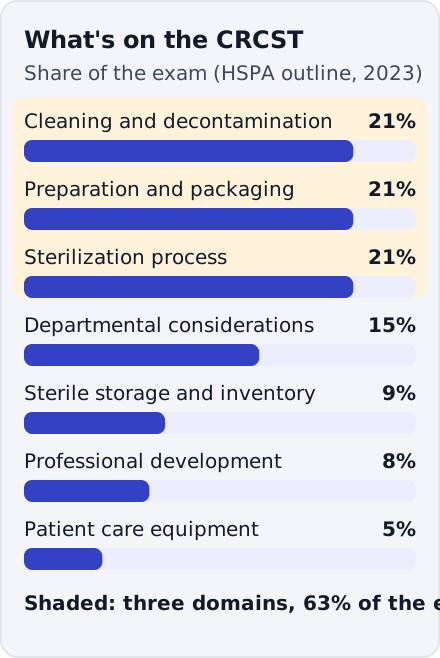
A practice test should follow these weights. If a set of 100 questions has 40 on sterilization and 2 on decontamination, your score tells you very little about the real exam.
One thing to check: HSPA published an older outline (2018, updated 2022) that is still on its website, and many prep sites still use it. That outline has different sections, such as Customer Relations and a separate Documentation section. Our questions follow the November 2023 outline, which is the one HSPA's CRCST page links to today.
What makes a practice test worth your time
Free CRCST questions are easy to find. Good ones are harder. When you look at any practice test, ours included, check these points:
- It explains the wrong answers. Knowing why choice B is wrong is often what helps on exam day, because the real distractors are close to the right answer.
- It matches the current material. HSPA's technical manual page says every CRCST question can be referenced to the 9th edition of the Sterile Processing Technical Manual (2023), ANSI/AAMI ST79 or AORN's guidelines. A set written for the 7th or 8th edition can teach you outdated details.
- It is original. Sets that claim to be "real exam questions" are either copied (which breaks HSPA's rules) or invented with a false label. Neither helps you.
- It scores you by domain. A single percentage hides the problem. You need to see that you scored 85% on storage and 50% on sterilization.
Our how we write questions page explains how each question is written from the standards and checked before it goes live.
How to use a practice test
- Take one cold. Do the free diagnostic before you start studying. It shows where you stand without guessing.
- Read every explanation. Read the ones you got right, too. A lucky guess and a solid answer look the same on the score sheet.
- Study your weakest domain first. Each domain has a free study guide. Start with the one where your score was lowest and the exam weight is highest.
- Drill by domain. Use the free practice questions by domain to check that the guide worked.
- Practice the pace. 150 questions in 180 minutes gives you 72 seconds per question. Most questions take less, so you have time to come back to the hard ones.
Worked example: one concept, one question
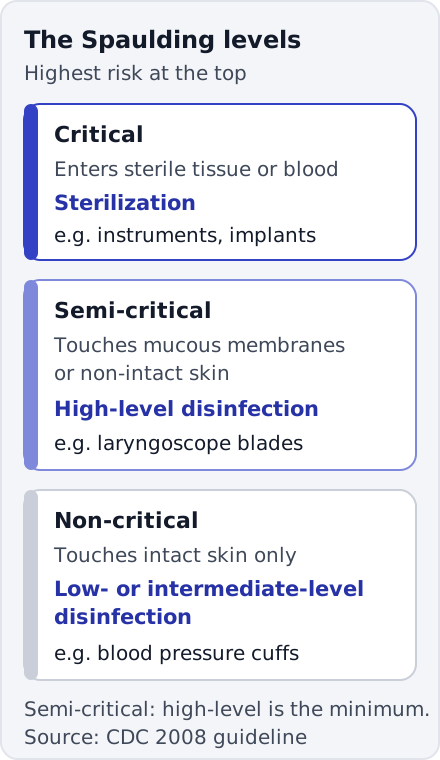
Many CRCST questions test a single rule inside a short scenario. The Spaulding classification is a good example, because it shows up in decontamination, patient care equipment and sterilization questions.
A laryngoscope blade comes back from the emergency department. What is the minimum level of processing it needs before it is used on the next patient?
- A. Low-level disinfection
- B. Intermediate-level disinfection
- C. High-level disinfection
- D. Cleaning only
Answer: C. The blade touches mucous membranes, so it is semi-critical. Under the Spaulding system in the CDC's 2008 Guideline for Disinfection and Sterilization, semi-critical items need high-level disinfection at a minimum. Choices A and B are for non-critical items that touch intact skin. Choice D skips disinfection completely, and cleaning alone does not kill enough microorganisms for an item that touches mucous membranes.
The question never says "semi-critical." You have to work out the category from what the item touches. Most CRCST questions test that step: applying a definition to a real item.
10 sample CRCST questions with answers
These ten come from our own question bank and cover all seven domains, with more from the three big ones. They are written for the 9th edition of HSPA's manual. Try each one before you read the answer.
1. Cleaning, Decontamination and Disinfection. A technician doubles the amount of enzymatic detergent in the sink because the instruments look especially bloody. What is the most likely result?
- A. Faster protein breakdown, so the soak time can be cut in half
- B. A solution strong enough to also disinfect the instruments
- C. No change at all, because enzymes cannot be overconcentrated
- D. More residue to rinse off, with no proven gain in cleaning
Answer: D. Detergents are tested and labeled at a specific dilution, water temperature, and contact time. Using more than the label calls for does not improve cleaning and leaves more residue to rinse off. Residues can harm devices or patients.
2. Cleaning, Decontamination and Disinfection. Which item should usually be kept out of a standard ultrasonic cleaner?
- A. A stainless steel needle holder with serrated jaws
- B. A set of stainless steel Army-Navy retractors
- C. A stainless steel hemostat after manual pre-cleaning
- D. A rigid telescope with optical lenses
Answer: D. Ultrasonic cleaning is meant for stainless steel instruments with crevices, hinges and serrations. The vibration can damage the lenses of rigid telescopes and the seals around them, so most telescope IFUs do not allow it. Check each device's IFU before placing it in the ultrasonic.
3. Preparation and Packaging. What does the external indicator tape on a wrapped pack show after a cycle?
- A. That the pack was exposed to the process
- B. That the contents of the pack are sterile
- C. That all critical variables were met inside the pack
- D. That the sterilizer passed its air-removal test
Answer: A. External indicator tape is a Class 1 process indicator. Its color change shows that the package was exposed to the sterilization process, which separates processed packs from unprocessed ones. It does not show that the contents are sterile.
4. Preparation and Packaging. A two-level rigid container set is being assembled. Where should internal chemical indicators be placed?
- A. On top of the upper basket only, where the user sees it first
- B. Taped to the outside of the container lid
- C. In the bottom level only, since it heats last
- D. In each level, at the hardest-to-reach spot per IFU
Answer: D. An internal chemical indicator goes where the sterilant is least likely to reach, as stated in the IFU. That is often the geometric center, or opposite corners in containers. In multi-level sets, each level gets its own indicator, because conditions can differ between levels. The user then checks each indicator when the set is opened.
5. Sterilization Process. After incubation, a processed steam BI shows no growth, and the unprocessed control BI from the same lot also shows no growth. How should this be interpreted?
- A. The sterilizer failed, so all loads since the last BI must be recalled
- B. The test is invalid; it must be repeated and the cause investigated
- C. The control result does not matter if the processed BI is negative
- D. The load passed because both BIs show no growth
Answer: B. A control BI is expected to grow. If it does not, the spores, the media or the incubator may be faulty, so the negative result on the processed BI means nothing. The test is repeated with a good lot and a working incubator, and the event is documented and investigated.
6. Sterilization Process. After the cooling period, a technician finds water droplets inside the wrap of an instrument tray. What should be done with the tray?
- A. Let it sit on the cart until it is dry, then release it
- B. Wipe the outside of the wrap dry and send it to storage
- C. Release it if the internal chemical indicator changed color
- D. Consider it contaminated and send it back to be reprocessed
Answer: D. Moisture can carry microorganisms through the wrap, so a wet pack is considered non-sterile. The tray is reprocessed, and the cause (load configuration, set weight, steam quality, drying time or cooling conditions) is investigated and documented.
7. Departmental Considerations. Which air pressure relationship is correct for the decontamination area compared with the areas around it?
- A. Negative pressure, with all air exhausted outdoors
- B. Positive pressure, so air flows out into the hallway
- C. Equal pressure, so no air moves between the rooms
- D. Negative pressure, with the air recirculated into prep
Answer: A. Decontamination is kept under negative pressure so air flows into the room and contaminants and aerosols stay inside. Its air is exhausted directly outdoors rather than recirculated to other areas.
8. Sterile Storage, Transport and Inventory Management. A hospital uses event-related sterility for its in-house processed trays. A technician finds a wrapped tray processed 14 months ago. The wrap is dry and intact, the tape is unbroken, and it has not been dropped or crushed. What should the technician do?
- A. Reprocess it, because wrapped trays expire after 12 months
- B. Leave it in stock; no event has compromised the package
- C. Open it to check the internal indicator, then return it to the shelf
- D. Reprocess it, because event-related sterility applies only to commercial items
Answer: B. With event-related sterility, an item stays sterile until something compromises the package, such as moisture, a tear, a broken seal, compression or a drop. This tray is dry and intact with no event, so it remains usable. Good stock rotation (FIFO) should keep trays from sitting this long.
9. Professional Development and Human Relation Skills. At the end of the shift, a printed OR schedule listing patient names and procedures is no longer needed. How should it be discarded?
- A. Kept in a desk drawer in SPD in case questions come up later
- B. In a secure shredding or confidential waste bin
- C. In the open paper recycling bin
- D. Torn in half and placed in the regular trash
Answer: B. Papers with patient names and procedures are protected health information under HIPAA. They must be disposed of securely, such as in a locked shredding bin, so no one can read them. Facility policy sets the exact method.
10. Patient Care Equipment and Distribution. An infusion pump comes back to SPD from a patient room with the IV tubing still loaded. Wearing PPE, what should the technician do first?
- A. Remove and discard the tubing and other single-use items
- B. Wipe the pump down with the tubing in place to save time
- C. Flush the tubing so it can be used on the next patient
- D. Send it to clean storage and remove the tubing when it is issued
Answer: A. Disposable items such as tubing, cassettes, canisters and sleeves are removed and discarded first, following bloodborne pathogen precautions. Only then can every surface of the equipment be cleaned and disinfected.
The free 25-question diagnostic uses the same kind of questions, weighted by HSPA's domain shares, and scores you by domain at the end.
What score means you are ready
HSPA does not publish a passing score. As our own benchmark, we treat 70% or more on our full mock exams as ready. HSPA does not set that number. For context, HSPA's certification statistics show 10,083 of 15,369 CRCST candidates passed in 2025, about 66%.
Frequently asked questions
Is the CRCST practice test on this site really free?
Yes. The 25-question diagnostic is free, with no account and no card. You get a score for each domain and an explanation for every question. The free practice questions on each domain page are free too.
How many questions are on the CRCST exam?
The CRCST exam has 150 multiple-choice questions, and you have three hours to finish. HSPA gives it on a computer at Prometric testing centers, and a paper version is not available.
What score do I need to pass the CRCST?
HSPA does not publish a passing score. Its 2026 handbook says 125 of the 150 questions are scored and 25 are unscored pretest questions. On our mock exams, we use 70% as the point where we consider you ready. That is our own benchmark.
Are Quizlet CRCST flashcards good enough?
Flashcards help with terms, but most free sets don't say which edition they were written from, and many contain errors. Use them for vocabulary. For exam practice, use questions that explain why each wrong answer is wrong and follow HSPA's 2023 outline.
Can I take the CRCST exam online from home?
HSPA's CRCST page says the exam is taken in person at a Prometric testing facility. It does not list an at-home option. Check HSPA's page before you apply in case this changes.
Which book should I study for the CRCST?
HSPA's CRCST page names the Sterile Processing Technical Manual, 9th edition (2023), and says ANSI/AAMI ST79 and AORN's guidelines were used as references in writing the exam. HSPA also says a course or study materials are not required to sit the exam.
Sources
Our Cleaning, Decontamination and Disinfection questions cite these documents, by document and, where we can confirm it, chapter or section.
- HSPA Sterile Processing Technical Manual (57 questions)
- ANSI/AAMI ST79 (25 questions)
- CDC Guideline for Disinfection and Sterilization (15 questions)
- OSHA 29 CFR 1910.1030 (7 questions)
- ANSI/AAMI ST58 (6 questions)
- ANSI/AAMI ST108 (5 questions)
- ANSI/AAMI ST91 (5 questions)
- OSHA 29 CFR 1910.1200 (1 question)
- OSHA 29 CFR 1910.151 (1 question)
We are not affiliated with HSPA and never see real exam questions. Every question is written from HSPA's public content outline and the standards it names, so nothing here is a leaked or recalled item. How we write questions
Questions? support@crcstready.com