


To become a fully certified CRCST, you need 400 hours of hands-on experience in a sterile processing department, paid or volunteer, plus a passing score on the exam. You can finish the hours before you test, or pass the exam first and finish them within six months as a provisional CRCST (HSPA).
How the 400 hours break down
HSPA sets a minimum number of hours in each work area. The total is 400.
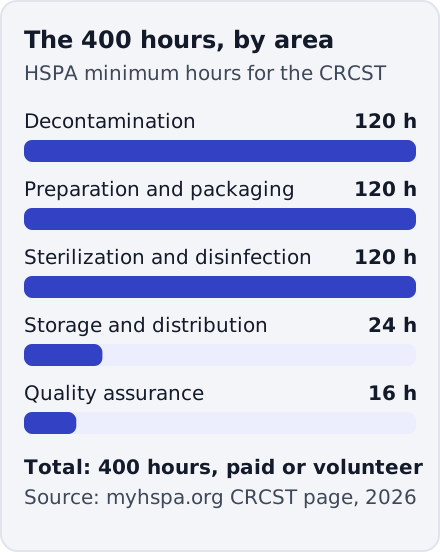
| Work area | Minimum hours |
|---|---|
| Decontamination | 120 |
| Preparing and packaging instruments | 120 |
| Sterilization and disinfection | 120 |
| Storage and distribution | 24 |
| Quality assurance processes | 16 |
| Total | 400 |
The split matters. 400 hours spent only in the prep area do not qualify, because decontamination and sterilization each need their own 120 hours. If you are volunteering or working in one area, ask your supervisor early about rotating you through the others.
Two ways to get there: full or provisional
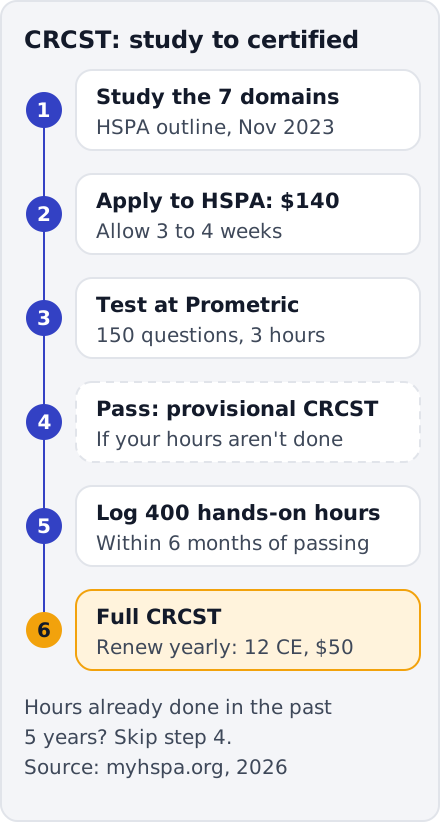
| Full CRCST | Provisional CRCST | |
|---|---|---|
| When you do the hours | Before you apply | After you pass the exam |
| Time window | Within the previous five years, before the application | Within six months of passing |
| What you hold after passing | Full CRCST | Provisional status until the hours are submitted |
| How hours are submitted | With your application | Provisional Certification Authentication Form |
HSPA calls full certification the recommended path. Provisional status helps if you are a student or new hire who wants to test while the material is fresh, then finish the hours on the job.
Who can sign off your hours
HSPA accepts verification from someone who physically saw you do the work. According to HSPA's CRCST page, that includes:
- lead technicians, coordinators and supervisors
- managers, chiefs, directors and administrators
- hospital-based educators or trainers
HSPA does not accept hours signed by another technician, by a private instructor, or by yourself. If you trained at a school, your instructor alone cannot document the hours. The person who signs must be someone at the facility where you did the work.
The six-month provisional deadline
If you test first, the six-month clock starts when you pass. Your documented hours must reach HSPA before the six months end.
- If you miss it: HSPA says you forfeit provisional status, and you must retake the exam (another $140).
- The one-time extension: HSPA offers a single 2-month extension to people who are currently working or volunteering in a sterile processing department. Your department supervisor has to request it, and the request must arrive before your provisional status expires.
Plan backwards from your exam date. At 40 hours a week, 400 hours is 10 weeks of full-time work. At 16 hours a week as a volunteer, it is 25 weeks, which is almost the whole six months. Part-time candidates should start the hours early or think about finishing them before testing.
Where people find hours
HSPA counts paid and volunteer hours equally. Common routes are:
- a job as an entry-level sterile processing aide or tech, where the employer trains you
- a school program that includes a clinical rotation in a hospital department
- volunteering in a hospital or surgery center sterile processing department
HSPA states that it does not provide placement services, so you need to arrange the department yourself. When you contact a hospital, ask for the sterile processing or central service manager, and mention that you need hours across all five work areas.
Audits and appeals
HSPA may select applications to verify. If yours is selected, you have 120 days to send the information they ask for. HSPA says that missing this deadline cancels the application and the exam fee is forfeited. If you disagree with an eligibility decision, you can send a written appeal to HSPA's Certification Council within 30 days.
Keep your own record as you go: dates, areas, hours and the name of the person who supervised you. It makes the authentication form easy to fill in.
Study while you log hours
The hours and the exam reinforce each other. Each work area maps to an exam domain, so use the free study guides for the area you are working in that week. When you rotate into decontamination, read the cleaning and decontamination guide and try the free decontamination questions. The CRCST exam page has the full exam format.
Frequently asked questions
Do I need the 400 hours before I take the CRCST exam?
No. You can take the exam first and hold provisional CRCST status. You then have six months after passing to complete and submit the 400 hours. You can also finish the hours first, within the five years before your application, and become fully certified as soon as you pass.
Do volunteer hours count toward the CRCST?
Yes. HSPA counts paid and volunteer hours the same way. They must be hands-on hours in a sterile processing department, split across the five work areas, and signed by someone who saw you do the work.
How are the 400 hours split?
HSPA requires 120 hours in decontamination, 120 in preparing and packaging instruments, 120 in sterilization and disinfection, 24 in storage and distribution, and 16 in quality assurance processes.
Can my school instructor sign my hours?
Not on their own. HSPA does not accept hours documented by private instructors, other technicians or yourself. A hospital-based educator or trainer who watched you work can sign, as can a lead tech, supervisor or manager at the facility.
What happens if I don't finish my hours in six months?
You lose provisional status and must retake the exam. If you are working or volunteering in a sterile processing department, your supervisor can request a one-time 2-month extension, but only before your provisional status expires.
How long do my 400 hours stay valid?
For full certification, HSPA asks for 400 hours completed within the five years before your application. Hours older than that do not count.
We are not affiliated with HSPA and never see real exam questions. Every question is written from HSPA's public content outline and the standards it names, so nothing here is a leaked or recalled item. How we write questions
Questions? support@crcstready.com