


A Bowie-Dick test checks whether a dynamic-air-removal steam sterilizer removes air, without air leaking back in, so steam can reach every part of the load. CDC says the test is used to detect air leaks and inadequate air removal (CDC, steam sterilization). A biological indicator (BI) checks whether the cycle actually killed a large population of highly resistant bacterial spores. The BI is the only routine monitor that directly shows microbial kill.
Both tests come up often on the CRCST, usually in questions that mix them up on purpose. The free 25-question CRCST diagnostic includes sterilization questions like these and gives that domain its own score.
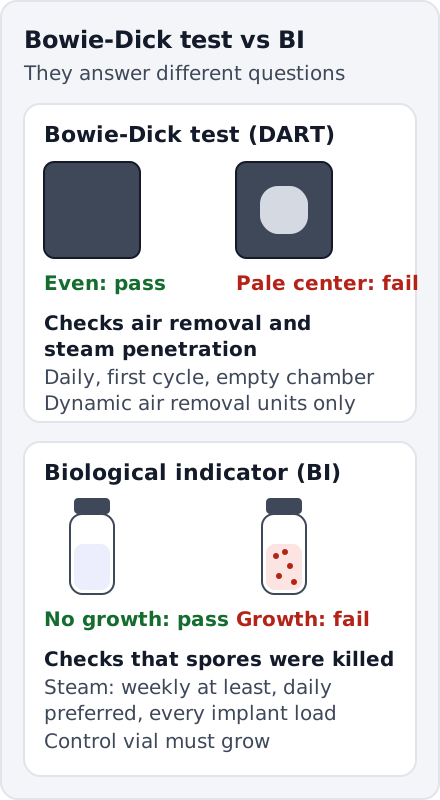
Side by side
| Bowie-Dick test (DART) | Biological indicator (BI) | |
|---|---|---|
| What it answers | Did the sterilizer remove the air so steam could reach the whole chamber? | Were the test spores killed? |
| What kind of test | A chemical indicator for a specific test (ISO 11140-1 Type 2) | A biological test with live spores |
| Sterilizers | Dynamic air removal (prevacuum) steam sterilizers only | Every sterilization method, using a BI labeled for that process |
| When (steam) | Daily, as the first cycle after warm-up | At least weekly, preferably daily, for each cycle type used, and in every load with an implant |
| Chamber | Empty, except for the test pack | Routine test: BI in a process challenge device in a full load |
| Result time | Read as soon as the cycle ends | After incubation, per the BI maker's instructions |
| Pass | Even, uniform color change across the sheet | No growth in the processed BI, and growth in the control |
| Fail | Pale or unchanged area, usually in the center | Growth in the processed BI |
The schedules above follow ANSI/AAMI ST79 practice for steam. CDC's sterilizing practices guidance gives the same core schedule: a daily air-removal (Bowie-Dick) test in an empty dynamic-air-removal sterilizer, BIs at least weekly, and a BI in each load that contains an implant. CDC adds that daily BI use finds equipment problems sooner. Always follow your sterilizer's and indicator's instructions for use (IFU). The details are in our sterilization process study guide.
How the Bowie-Dick test works
A prevacuum sterilizer pulls air out with vacuum pulses before steam comes in. The Bowie-Dick sheet changes color evenly only if no air was left in the pack. A pale center means air stayed behind. Common causes are an air leak, a worn door gasket, a failing vacuum pump or poor steam quality.
The test runs daily in an empty chamber and is never used in gravity sterilizers. Our Bowie-Dick test page shows how to run and read it step by step.
How a biological indicator works
A BI holds a known population of bacterial spores that are very hard to kill. For steam and hydrogen peroxide gas plasma, the spores are Geobacillus stearothermophilus. For ethylene oxide and dry heat, they are Bacillus atrophaeus (CDC). If the cycle kills these, it is reasonable to trust it with the far less resistant organisms on instruments.
After the cycle, the BI is incubated at the temperature its IFU gives, along with a control BI from the same lot that was not sterilized. The control must grow. If it doesn't, the test proves nothing, because the spores may not have been alive to start with, or the incubator may not be working. The test must then be repeated.
For routine steam monitoring in a large sterilizer, the BI goes inside a process challenge device (PCD) on the bottom shelf, near the front, over the drain, in a full load. That spot is the hardest place in the chamber for steam to reach. CDC describes the same spot: the front, bottom section of the sterilizer, near the drain.
What to do when a test fails
Failed Bowie-Dick test: the sterilizer comes out of service until it is inspected, repaired and passes a retest. The steps are on our Bowie-Dick test page, under "What to do when it fails".
Positive BI (growth):
- Take the sterilizer out of service and notify your supervisor and infection prevention.
- Repeat the spore test right away. CDC says that if the sterilizer's mechanical and chemical indicators show it working properly, a single positive spore test probably doesn't mean the sterilizer has failed, but the test should be repeated immediately. If repeat tests are also positive, CDC says to stop using the sterilizer until it is serviced (CDC, sterilizing practices).
- Quarantine the loads processed since the last negative BI and follow your facility's recall policy. CDC says items other than implants don't need to be recalled for a positive steam BI unless a sterilizer malfunction is found.
- Find the cause, retest and document everything.
Load records make the recall possible. Every package carries a load number that links it to the sterilizer, date and cycle. The sterile storage guide covers how recalled items are pulled.
After installation or major repair
Before patient loads are run in a new, moved or majorly repaired sterilizer, ST79 practice calls for three consecutive BI PCD cycles in an otherwise empty chamber. Dynamic-air-removal sterilizers also need three consecutive Bowie-Dick tests. All of them must pass. CDC's sterilizing practices page describes the same three-cycle check and says the sterilizer is not put back into use until all the BIs are negative.
Exam traps
These are the mix-ups CRCST questions are built around:
- "Which test shows the load is sterile?" Neither test proves a given pack is sterile. The BI is the only one that shows kill. A chemical indicator only shows the pack was exposed to the process.
- "A gravity sterilizer needs a daily Bowie-Dick test." False. Bowie-Dick is for dynamic air removal only.
- "Run the Bowie-Dick in a full load." False. It runs in an empty chamber.
- "The control BI didn't grow, so the load passed." False. A control that doesn't grow makes the test invalid.
- "An implant can go out once the integrating indicator passes." Only in a documented emergency, with early-release paperwork and follow-up on the BI. Otherwise, implants wait for the BI result.
A free question from our bank that tests the schedule:
According to AAMI ST79, how often should a steam sterilizer be routinely monitored with a BI process challenge device (PCD)?
- A. At least weekly, and preferably daily, per cycle type
- B. Only on days when the Bowie-Dick test has failed
- C. Only after the sterilizer has been repaired or moved
- D. Once a month, in the first load of each month
Answer: A. Routine BI monitoring is at least weekly, preferably every day the sterilizer runs, for each cycle type, plus every load with an implant. B mixes up the two tests: a failed Bowie-Dick takes the sterilizer out of use. C describes qualification testing, which comes on top of routine monitoring.
The free CRCST diagnostic has more questions like this across all seven domains and scores each one. For this topic alone, try the free sterilization practice questions or see how to read a sheet on our Bowie-Dick test page.
Frequently asked questions
What is the difference between a Bowie-Dick test and a biological indicator?
A Bowie-Dick test checks that a prevacuum steam sterilizer removes air, with no leaks letting air back in, so steam reaches the whole chamber. A biological indicator checks that the cycle killed a population of resistant spores. The Bowie-Dick result is read right after the cycle. The BI result comes after incubation.
How often is a Bowie-Dick test done?
Daily, in each dynamic air removal steam sterilizer, as the first cycle after the sterilizer warms up, with the chamber empty except for the test pack. Gravity-displacement sterilizers do not use it.
How often are biological indicators run for steam?
For steam, at least weekly and preferably daily, for each type of cycle used, plus in every load that contains an implant. Ethylene oxide loads get a BI in every load.
Is a Bowie-Dick test a chemical indicator?
Yes. It is a chemical indicator made for one specific test, classed as Type 2 under ISO 11140-1. It shows whether air removal worked. Whether the cycle killed spores is a question for the biological indicator.
What does a pale center on a Bowie-Dick sheet mean?
It means air stayed in the test pack and steam did not reach the center. The test has failed. The sterilizer should be taken out of service, checked and retested before it runs patient loads.
What should you do if a biological indicator is positive?
Take the sterilizer out of service, notify your supervisor and infection prevention, and repeat the spore test right away, as CDC advises. Quarantine loads back to the last negative BI under your facility's recall policy. Then find the cause and document the event. If repeat tests are also positive, CDC says the sterilizer stays out of use until it is serviced.
Sources
Our Sterilization Process questions cite these documents, by document and, where we can confirm it, chapter or section.
- HSPA Sterile Processing Technical Manual (61 questions)
- ANSI/AAMI ST79 (34 questions)
- ANSI/AAMI ST41 (5 questions)
- OSHA 29 CFR 1910.1047 (2 questions)
- ANSI/AAMI ST58 (1 question)
We are not affiliated with HSPA and never see real exam questions. Every question is written from HSPA's public content outline and the standards it names, so nothing here is a leaked or recalled item. How we write questions
Questions? support@crcstready.com