

Sterile processing technician training teaches you to clean, inspect, package and sterilize surgical instruments. You can take a program at a community college or technical school, or an online course such as Purdue's, which is offered with HSPA. You can also learn on the job in a hospital sterile processing department and be paid while you train. The courses we checked cost $350 to $3,240.
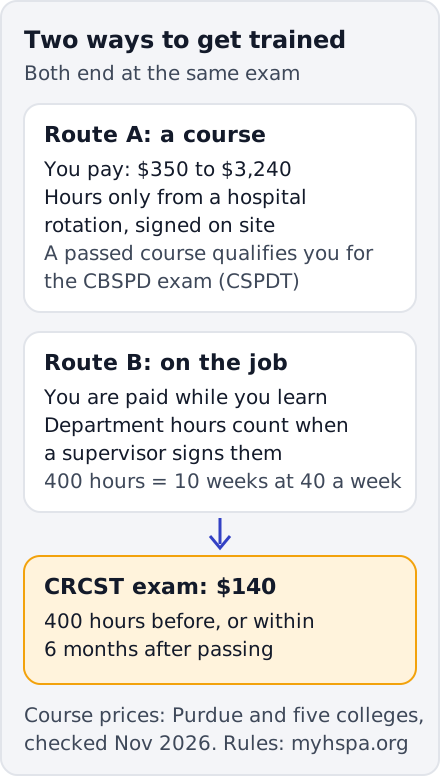
A course isn't required for the CRCST. HSPA requires 400 hours of hands-on work in a sterile processing department and says the courses it lists "are not a requirement" (HSPA training courses). For CBSPD's CSPDT, a passed course is one way to qualify.
Not sure whether you need a course at all? The free 25-question CRCST diagnostic scores each exam domain, which shows how much you already know.
Finding a program near you
Community colleges and technical schools run sterile processing programs in person and online, often through their continuing education or workforce training departments. To find one near you, check those pages at your local colleges, and look at the list of courses that schools have submitted to CBSPD at cbspd.net/spd-courses. CBSPD says it is not affiliated with those schools, and HSPA does not endorse any program.
Some colleges publish their prices. These are examples we checked on each college's own page in November 2026, not recommendations:
| Program | Published price | What it covers |
|---|---|---|
| Community College of Baltimore County (MD), Central Service Technician | $2,063 for the 109-hour course series | Includes the CRCST exam fee and the theory textbook. An optional 400-hour clinical adds $752. Listed as approximate. |
| Anne Arundel Community College (MD), Central Sterile Processing Technician | $2,050 for county residents | Tuition and fees. Books, scrubs and the CRCST exam are extra. Externship options available. |
| College of DuPage (IL), Central Sterile Processing Distribution Technician | $2,201.87 plus clinical requirements | 12 credits at the in-district rate of $160 a credit, plus fees. Background check and drug test are separate. |
| Oakland Community College (MI), Sterile Processing Technician | $2,500 plus drug screen, immunizations and background check | Includes 96 hours of hospital clinical experience. Listed for the Winter 2027 cohort. |
| Dallas College (TX), Sterile Processing Technician | $3,240 estimated tuition for in-county residents | Most learning materials included. About 4 months full time. |
Out-of-district students usually pay more, so check the price for where you live.
Ask each program:
- Does it include a hospital rotation, and how many hours? A rotation is where most students get department hours.
- Who signs the hours? HSPA won't accept hours documented by a private instructor, another technician or yourself. A manager, supervisor, lead tech, coordinator or hospital educator who watched you work has to sign.
- Which exam does it prepare you for? For the CSPDT, CBSPD accepts a sterile processing course with a grade of 70 or higher as one eligibility route.
- What is the full cost? Ask whether books, scrubs, background checks and the exam fee are included.
Training routes compared
| Route | What it gives you | Cost | Counts toward the CRCST 400 hours? |
|---|---|---|---|
| Purdue online course (offered with HSPA) | Self-paced lessons, one year of access, HSPA's technical manual and workbook, a proctored final | $518 with books (continental US), $350 without | No |
| College or technical school program | Classes, and in some programs a hospital rotation | Set by each school; $2,050 to $3,240 at the five colleges listed above | Only hands-on hours in a sterile processing department, signed by a qualified person at that facility |
| On-the-job training | Paid work in a department while you learn | You are paid | Yes, when signed by a supervisor who saw the work |
| Self-study | HSPA's manual and the standards it is based on | Cost of books | No |
Sources: Purdue's course page, HSPA's CRCST page and Certification Handbook (revised January 2026). Prices checked November 2026.
Online courses
The best-known online option is Purdue University's Sterile Processing Online Technical Training, offered in partnership with HSPA. Purdue lists it at $518 with books shipped in the continental US, or $350 if you already have the manual. You get one year of access, with a paid extension available. The final exam is proctored by someone you choose and is built to resemble the CRCST.
Two limits to know before you pay:
- Purdue says the course does not include the 400 hours, and it can't place you in a department.
- HSPA's handbook says passing a course "does not equate to Certification." You still apply to HSPA and pay the $140 exam fee.
HSPA also sells its technical manual as an e-book, which Purdue's page lists at $79 with two years of access.
On-the-job training
Some hospitals hire entry-level staff and train them in the department. BLS lists the typical entry-level education for medical equipment preparers, its category for sterile processing techs, as a high school diploma or equivalent, with moderate-term on-the-job training (BLS education and training table).
This route pays you while you learn, and every hour in the department can count toward the CRCST, as long as you rotate through all five areas. HSPA asks for at least 120 hours each in decontamination, preparation and packaging, and sterilization and disinfection, plus 24 in storage and distribution and 16 in quality assurance. Our CRCST 400 hours guide has the rules.
How the hours fit with training
You can finish the 400 hours before the exam, or pass first and finish them within six months as a provisional CRCST. HSPA does not provide placement, so if your course has no rotation, start looking for a department early. At 40 hours a week, 400 hours takes about 10 weeks. At 16 hours a week, it takes 25 weeks, close to the whole six-month window.
Studying without a course
You can also prepare on your own. HSPA says the CRCST was built from its Sterile Processing Technical Manual (9th edition), ANSI/AAMI ST79 and AORN's guidelines. A course teaches the reasons behind department rules, and the exam tests those reasons. Two free questions from our bank show the kind of judgment it asks for:
1. During inspection under lighted magnification, a technician sees dried debris in the box lock of a needle holder that came through the washer-disinfector. What is the correct action?
- A. Spray it with instrument lubricant to loosen the debris
- B. Package it, since steam will penetrate the dried debris
- C. Wipe the box lock with a damp cloth at the prep station
- D. Return it to decontamination for recleaning
Answer: D. An instrument with visible soil goes back to decontamination, because soil can shield microorganisms from the sterilant. Lubricant (A) coats the soil instead of removing it. Wiping at the prep station (C) doesn't reach into the box lock and brings soil into a clean area.
2. A technician is loading a washer-disinfector rack with a general surgery set. Which practice is correct?
- A. Close ratchets on the first tooth to keep instruments in place
- B. Stack trays closely so more fit in each cycle
- C. Cover the rack with a towel to hold small items in place
- D. Open hinged instruments and leave room for the spray
Answer: D. A washer-disinfector cleans by spraying every surface, so box locks and jaws must be open and the rack must not be crowded. Closed ratchets, tight stacking and a towel all block the spray.
To decide between a course and self-study, take the free 25-question CRCST diagnostic. It scores each of HSPA's seven domains. Low scores across most domains suggest a course would help. Low scores in one or two suggest the matching study guides may be enough.
- How to pass the CRCST, with a six-week plan
- The CRCST exam: format, cost and scheduling
Frequently asked questions
Do you need training to become a sterile processing technician?
No. HSPA does not require a course for the CRCST. It requires 400 hands-on hours in a sterile processing department and a passing exam, and you can learn on the job. A course is one of four ways to qualify for CBSPD's CSPDT.
How much does sterile processing technician training cost?
From $350 to $3,240 for the courses we checked, and nothing for on-the-job training, which is paid work. Purdue's online course, offered with HSPA, is listed at $518 with books in the continental US, or $350 without books. School programs set their own prices; the five college programs we checked publish prices from $2,050 to $3,240 for local residents, and some add clinical, book or exam costs on top. The CRCST exam fee of $140 is separate.
How long is sterile processing technician training?
There is no set length. Purdue's online course gives one year of access and is self-paced. School programs vary. The 400 hands-on hours for the CRCST take about 10 weeks at full-time hours.
Do online courses count toward the 400 hours?
No. HSPA counts only hands-on hours in a sterile processing department, signed by a manager, supervisor, lead tech, coordinator or hospital educator who saw the work. Purdue says its online course does not provide those hours.
Can I train on the job instead of taking a course?
Yes. BLS lists moderate-term on-the-job training as typical for medical equipment preparers, and HSPA counts paid and volunteer department hours the same way. Make sure you rotate through all five work areas.
Where can I find a sterile processing program near me?
Check community colleges and technical schools in your area, and CBSPD's list of submitted courses at cbspd.net/spd-courses. Ask each one whether it includes a hospital rotation and who signs the hours.
We are not affiliated with HSPA and never see real exam questions. Every question is written from HSPA's public content outline and the standards it names, so nothing here is a leaked or recalled item. How we write questions
Questions? support@crcstready.com