


A Bowie-Dick test is a daily air-removal test for prevacuum steam sterilizers: a test pack with an indicator sheet in its center is run alone in the chamber, and an even color change across the sheet shows the sterilizer removed the air so steam could reach the middle of the pack. The CDC describes it as a test for air leaks and inadequate air removal (CDC steam sterilization guidance).
If air stays in the chamber, steam can't touch every surface, and items may not be sterilized. The test finds that problem before patient loads go in.
Bowie-Dick test at a glance
| Bowie-Dick test | |
|---|---|
| What it checks | Air removal and steam penetration; also picks up air leaks |
| Sterilizers | Dynamic-air-removal (prevacuum) steam sterilizers only |
| When | Each day the sterilizer is used, before the first processed load |
| Also run | Three consecutive empty cycles after installation, relocation, major repair or a sterilization failure |
| Chamber | Empty except for the test pack |
| Placement | Lying flat on the bottom rack, at the front near the door, over the drain |
| Cycle (CDC) | 134°C (273°F) for 3.5 minutes; follow the test pack's instructions for use |
| Pass | Uniform color change across the sheet |
| Fail | A spot or paler area where trapped air kept steam out |
Sources: CDC steam sterilization and sterilizing practices guidance. ANSI/AAMI ST79 sets the US practice for steam sterilization in health care. Your sterilizer's and test pack's instructions for use (IFU) come first.
What the Bowie-Dick test is used for
A prevacuum sterilizer pulls air out with vacuum pulses before steam comes in. If a door gasket leaks or the vacuum system isn't working well, air stays behind and collects in the center of packs. The Bowie-Dick test is built to catch exactly that.
It does not show that a load is sterile. That is the job of the biological indicator. Our Bowie-Dick test vs biological indicator page compares the two side by side.
Gravity-displacement sterilizers don't get a Bowie-Dick test. They don't use vacuum to remove air, and the CDC describes the test for dynamic-air-removal sterilizers.
The test pack
The original test pack was a stack of folded 100% cotton surgical towels, clean and preconditioned, with a Bowie-Dick-type test sheet in the center. The CDC notes that smaller disposable test packs, also called process challenge devices, were developed to replace the towel stack.
The indicator sheet is a chemical indicator made for this one test. ISO 11140-1, the standard for sterilization chemical indicators, calls it a Type 2 (specific test) indicator. HSPA's own CRCST lesson on indicator classifications uses the same Type 1 to 6 numbering (HSPA lesson CRCST 185, 2022). Older books may say "Class 2."
How to run a Bowie-Dick test
- Warm up the sterilizer as its IFU directs.
- Empty the chamber. The test pack goes in alone.
- Place the pack flat on the bottom rack, at the front near the door, over the drain.
- Run the Bowie-Dick cycle your sterilizer offers, or the time and temperature on the test pack's IFU. The CDC gives 134°C for 3.5 minutes.
- Remove the pack when the cycle ends, open it and take out the sheet.
- Read and record the result before any patient load runs. Keep the sheet or record as your department's policy requires.
How to read the result
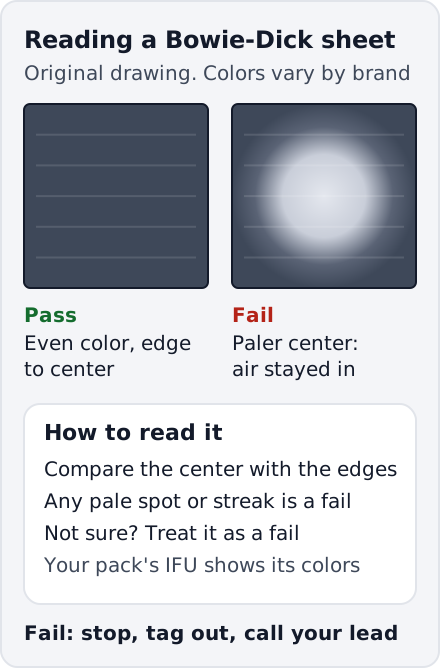
Lay the sheet flat in good light and compare its center with its edges.
- Pass: the color change is even from edge to center.
- Fail: there is a lighter spot or uneven area, usually in the center. That spot is where air stayed in the pack.
The drawing above is our own and shows the pattern, not a brand's colors. Each test pack's IFU shows its own pass and fail examples, and those are what you match against. If you are unsure, treat it as a fail and ask your supervisor before using the sterilizer.
If you're studying for the CRCST, reading sheets like this is part of the Sterilization Process domain. The free 25-question diagnostic scores you on it along with the other six domains.
What to do when it fails
The CDC says not to use the sterilizer until maintenance staff have inspected it. The steps:
- Don't run patient loads in that sterilizer.
- Tell your supervisor and take the sterilizer out of service.
- Have it inspected and repaired.
- Retest. It returns to service only after a passing test.
After installation, relocation or major repair, the CDC calls for three consecutive empty cycles with a Bowie-Dick test in a prevacuum sterilizer, along with biological indicator testing. Items processed during those evaluation cycles are quarantined until results are negative.
The Bowie-Dick test on the CRCST
Sterilizer testing falls under the Sterilization Process domain, about 21% of the CRCST. Expect questions that ask which sterilizers need the test, when it runs, where the pack goes and what a failed sheet looks like. Watch for answer choices that put the test in a gravity sterilizer or a full load.
Two free questions from our bank:
1. When should the Bowie-Dick test be run on a prevacuum steam sterilizer?
- A. Each day, in the last load of the day along with other packs
- B. Once a week, in a chamber that is fully loaded
- C. Daily, in an empty chamber, in the first cycle after warm-up
- D. Only after a biological indicator has come back positive
Answer: C. The test runs each day the sterilizer is used, alone in the chamber, before the first patient load. Other items in the chamber would change how the pack responds (A, B), and it is a routine test, not a follow-up to a failure (D).
2. What does an automated vacuum leak test on a dynamic-air-removal steam sterilizer check?
- A. Whether the incoming steam is at least 97% dry steam
- B. Whether wrapped packs are fully dry at the end of the cycle
- C. Whether air leaks into the chamber while it is under vacuum
- D. Whether bacterial spores are killed during the exposure phase
Answer: C. The sterilizer pulls a vacuum, holds it and measures how much the pressure rises. Leaking air can mix with steam and keep it off devices. The leak test runs as often as the sterilizer's maker recommends. Spore kill (D) is the biological indicator's job.
The free CRCST diagnostic has questions like these across all seven domains and scores each one. For more on this topic, read the sterilization process guide or try the free sterilization practice questions.
Frequently asked questions
What is a Bowie-Dick test used for?
A Bowie-Dick test checks that a prevacuum steam sterilizer removes air from the chamber so steam can reach the center of a load. The CDC describes it as a test for air leaks and inadequate air removal. It does not prove that a load is sterile.
What is a Bowie-Dick test pack?
A Bowie-Dick test pack is a challenge pack with a chemical indicator sheet in its center. The original version was a stack of folded cotton surgical towels. Smaller disposable test packs were later developed to replace the towels.
When is the Bowie-Dick test done?
The CDC says it is done each day the vacuum-type steam sterilizer is used, before the first processed load. It is also run in three consecutive empty cycles after installation, relocation or major repair.
Why is the Bowie-Dick test run in an empty chamber?
The test is meant to measure the sterilizer's air removal on its own. CDC guidance calls for the pack to sit on the bottom rack, near the door and over the drain, in an otherwise empty chamber.
Do gravity sterilizers need a Bowie-Dick test?
No. The test is for dynamic-air-removal (prevacuum) steam sterilizers, which use vacuum to pull air out. Gravity-displacement sterilizers don't remove air that way, so the test doesn't apply.
What does a failed Bowie-Dick test look like?
A failed sheet has a spot or paler area, usually in the center, instead of an even color change. The CDC says the sterilizer should not be used until maintenance staff have inspected it, and it returns to service only after a passing retest.
Sources
Our Sterilization Process questions cite these documents, by document and, where we can confirm it, chapter or section.
- HSPA Sterile Processing Technical Manual (61 questions)
- ANSI/AAMI ST79 (34 questions)
- ANSI/AAMI ST41 (5 questions)
- OSHA 29 CFR 1910.1047 (2 questions)
- ANSI/AAMI ST58 (1 question)
We are not affiliated with HSPA and never see real exam questions. Every question is written from HSPA's public content outline and the standards it names, so nothing here is a leaked or recalled item. How we write questions
Questions? support@crcstready.com