


Sterile processing technician certification in the US means one of two national credentials: the CRCST from HSPA or the CSPDT from CBSPD. Seven states require certification to work in sterile processing: Connecticut, Delaware, Minnesota, New Jersey, New York, Pennsylvania and Tennessee (HSPA legislative page). In the other states, the employer decides.
HSPA lists Florida, Oregon and South Carolina as states with active legislation or regulation.
The seven state laws
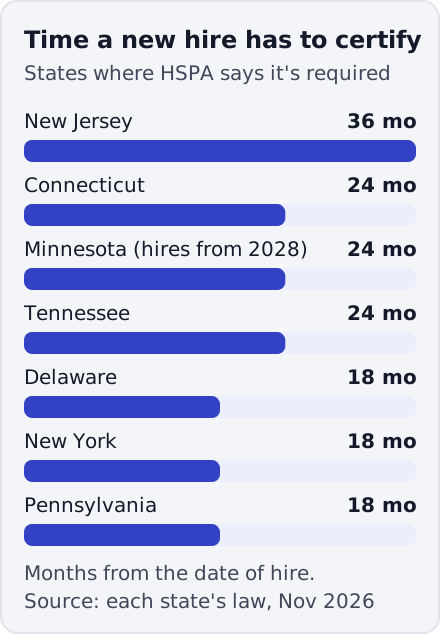
| State | Credentials named | New hires must certify within | Yearly CE |
|---|---|---|---|
| Connecticut | CRCST or CSPDT | 2 years | 10 hours |
| Delaware | CRCST or CSPDT | 18 months | 10 hours |
| Minnesota | CRCST, CSPDT, CER or CFER | 24 months, for hires from 2028 | 10 hours |
| New Jersey | A national program the state health department recognizes | 3 years | Yearly competency check; no set hours |
| New York | CRCST, CSPDT or a substantially equivalent credential | 18 months, or 2 years under the diligent-effort exception | 10 hours |
| Pennsylvania | CRCST or CSPDT | 18 months | 10 hours |
| Tennessee | CRCST or CSPDT | 2 years | 10 hours |
Each state links to the law or rule text we read in November 2026. Pennsylvania's link is HSPA's FAQ on the law.
Details that change who is covered:
- Which workplaces. The Delaware, Minnesota, Pennsylvania and Tennessee laws cover hospitals and ambulatory surgery centers. New Jersey's rule is a hospital licensing standard.
- Grandfathering. Techs already working before each law's cutoff are exempt from the exam. The cutoffs include January 1, 2017 in Tennessee, December 29, 2020 in Pennsylvania, January 1, 2023 in Delaware and December 31, 2027 in Minnesota. Most still owe the yearly CE.
- New York's diligent-effort exception. If a facility can't find enough qualified techs after a diligent and thorough effort, and keeps a written record of that effort, it can hire someone who isn't qualified yet. That person then has two years from the start of work to certify (N.Y. Public Health Law 2824, subdivision 6).
- Exemptions. The Delaware, Minnesota, Pennsylvania and Tennessee texts exempt licensed health care practitioners working within their scope, such as nurses.
Laws change. Before you rely on a deadline, read the current text or ask the hospital's sterile processing manager.
If you work in one of these states and aren't certified yet, the free 25-question CRCST diagnostic shows how far you are from test-ready, domain by domain.
Which credential to get
In six of the seven states the law names both credentials, so state law rarely forces the choice. Your eligibility usually does:
- You can get into a hospital department. The CRCST fits. You can test first and finish 400 hands-on hours within six months as a provisional CRCST. See the CRCST 400 hours guide.
- You finished a course but have no department hours. The CSPDT lets you test on the course route with a grade of 70 or higher. The CRCST still needs the 400 hours.
- You plan to work with endoscopes in Minnesota. The Minnesota law also accepts the CER (HSPA) and the CFER (CBSPD), the endoscope credentials.
Exam size, fees, renewal rules, five-year cost and pass rates for the two credentials are compared side by side on our CRCST vs CBSPD page. The CSPDT application is covered on the CBSPD exam page.
A note on the state CE rules
State CE and board CE are separate requirements. A CRCST holder in New York, for example, needs 12 CE credits a year for HSPA and 10 hours a year under state law. Ask your employer how it records the state hours and whether your HSPA CE counts toward them.
Certifications after the technician level
Both boards offer more credentials once you are working. HSPA's include the CIS for instruments, the CER for endoscopes and the CHL for leaders. The CIS and CHL require a current CRCST. See HSPA certification for the full list.
Preparing for the exam
Whichever credential you pick, plan your study around your state's deadline or your employer's. The free 25-question CRCST diagnostic scores each of HSPA's seven domains, so you know where to start. Most of the topics overlap with the CSPDT, so the score is a fair first check for either exam.
- The CRCST exam: format, cost and scheduling
- How to pass the CRCST: a six-week plan
- Sterile processing technician salary
Frequently asked questions
Which states require sterile processing certification?
Seven, according to HSPA: Connecticut, Delaware, Minnesota, New Jersey, New York, Pennsylvania and Tennessee. HSPA lists Florida, Oregon and South Carolina as states with active legislation or regulation.
How long do I have to get certified after I'm hired?
It depends on the state. New hires have 18 months in Delaware, New York and Pennsylvania, two years in Connecticut, Minnesota and Tennessee, and three years under New Jersey's hospital rule. Minnesota's requirement applies to techs hired from 2028. In New York, someone hired under the diligent-effort exception has two years.
What certification do you need to be a sterile processing technician?
The CRCST from HSPA or the CSPDT from CBSPD. Six of the seven state laws name both, and many hospital job posts list one or both. Minnesota also accepts the CER and CFER endoscope credentials.
Is the CRCST or the CSPDT better?
Neither is better everywhere. The CRCST needs 400 hands-on hours and renews yearly. The CSPDT can be taken after a training course and renews every five years. Check which one employers name where you plan to work.
Do I need certification if my state has no law?
Not by law, but many employers require or prefer it. Some hire uncertified techs and set their own deadline to certify. Read the job post.
How much does sterile processing certification cost?
The CRCST exam costs $140 and the CSPDT exam costs $135, before any training costs. Renewal is $50 a year for the CRCST and $135 every five years for the CSPDT. Check each board's current fees before you apply.
We are not affiliated with HSPA and never see real exam questions. Every question is written from HSPA's public content outline and the standards it names, so nothing here is a leaked or recalled item. How we write questions
Questions? support@crcstready.com