


HSPA (the Healthcare Sterile Processing Association) offers five certifications: the CRCST for sterile processing technicians, the CIS for instrument specialists, the CER for endoscope reprocessors, the CHL for leaders and the CCSVP for vendors (HSPA certification overview). When people say "HSPA certification," they usually mean the CRCST, the entry-level credential the others build on.
HSPA was called IAHCSMM until it adopted its current name in 2022 (HSPA), so older job posts and books may use the old name.
The five HSPA certifications
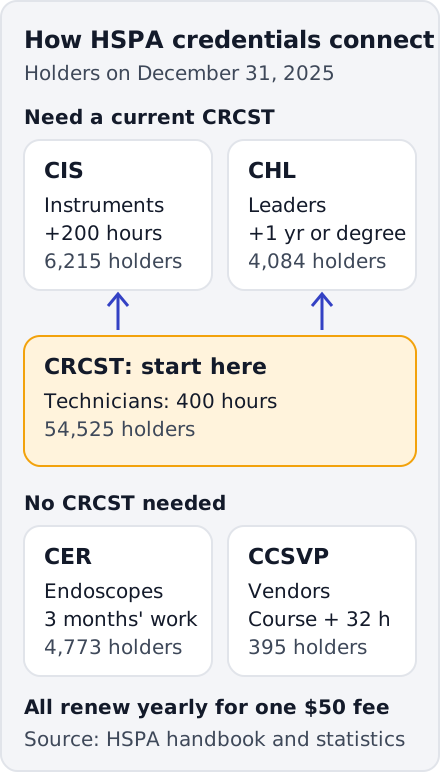
| Credential | For | Before you apply | Exam | Yearly CE | Holders (Dec. 31, 2025) |
|---|---|---|---|---|---|
| CRCST | Technicians | 400 hands-on hours (before or within 6 months after passing) | 150 questions, 3 hours, $140 | 12 | 54,525 |
| CIS | Instrument specialists | Full CRCST, plus 200 more hands-on hours | 150 questions, 3 hours, $140 | 6, plus a current CRCST | 6,215 |
| CER | Endoscope reprocessors | 3 months of hands-on endoscope reprocessing | 150 questions, 3 hours, $140 | 6 | 4,773 |
| CHL | Managers and supervisors | Current CRCST, plus a year of experience or a degree (since October 2026) | 150 questions, 3 hours, $140 | 6, plus a current CRCST | 4,084 |
| CCSVP | Vendors | HSPA's online course and 32 hours of observation | 100 questions, 2.25 hours | 6 | 395 |
Sources: HSPA's Certification Handbook (revised January 2026) and certification statistics. The 150-question exams each have 125 scored questions and 25 unscored pretest questions. All are taken at Prometric test centers.
CRCST: the starting point
The Certified Registered Central Service Technician is for technicians who clean, inspect, package and sterilize surgical instruments. You need 400 hours in a sterile processing department: 120 each in decontamination, preparation and packaging, and sterilization and disinfection, 24 in storage and distribution and 16 in quality assurance. You can test before finishing them and hold provisional status for six months.
See the CRCST exam for format and scheduling, and what CRCST stands for for the basics.
CIS: instruments
The Certified Instrument Specialist tests instrument identification, inspection, testing and assembly. HSPA requires full CRCST certification first, plus 200 more hands-on hours that can't overlap with your CRCST hours. The handbook splits them across six areas, including 8 hours of surgical procedure observation (HSPA Certification Handbook, CIS section, page 9). You must keep the CRCST current to keep the CIS.
CER: endoscopes
The Certified Endoscope Reprocessor covers pre-cleaning, testing, decontamination, disinfection or sterilization, transport and storage of endoscopes. HSPA asks for at least three months of hands-on endoscope reprocessing before you apply. The handbook does not list the CRCST as a requirement for the CER.
CHL: leadership
The Certified Healthcare Leader is for people who run a sterile processing department. Its four domains are planning and decision making, organizing, leading and controlling. A current CRCST is required.
Since October 2026, CHL applicants also need one of these: 12 months (2,080 hours) of sterile processing work, 12 months (2,080 hours) in a leadership role, or an associate degree or higher. Applications HSPA received before October 2026 are processed under the old rules. Current CHL holders must meet the new rules before October 2027 (HSPA program updates).
CCSVP: vendors
The Certified Central Service Vendor Partner is for sales and service representatives who work with sterile processing departments. HSPA's required online course costs $375 and includes the technical manual and one exam attempt. You also need 32 hours of observation split between two facilities. HSPA says people who already hold a higher certification, such as the CRCST, can't apply for the CCSVP.
Retired credentials: CHMMC and ACE
You may still see two older HSPA credentials on resumes and signatures: the CHMMC (Concepts in Healthcare Materiel Management Certificant) and the ACE (Approved Certified Educator). HSPA no longer offers either one. Its handbook calls them retired credentials, but people who already hold them can keep them as long as they meet the yearly renewal rules (HSPA Certification Handbook). A CHMMC needs 6 CE a year in materials management. An ACE needs a current CRCST and attendance at HSPA's annual Educator's Update at least once every two years.
Renewal: one fee, separate CE
Every HSPA certification renews every year. One $50 fee covers all the HSPA certifications you hold, but each one needs its own CE credits, as shown in the table. Renewals are due by the last day of your CRCST anniversary month, and any other HSPA certifications renew in the same month. The CRCST renewal page covers what counts as CE.
Employers can check any HSPA credential online. See CRCST verification.
Where to start
If you are new to sterile processing, the CRCST comes first. Its exam already touches the topics the specialty credentials go deeper on. Two free questions from our CRCST bank:
1. Instruments (the CIS goes deeper). Which type of stainless steel is usually used for scissors and clamps because it can be hardened to hold an edge?
- A. 300-series (austenitic) stainless steel
- B. 400-series (martensitic) stainless steel
- C. Anodized aluminum alloy
- D. Chrome-plated brass
Answer: B. 400-series steel can be heat-hardened, so it keeps a cutting edge and stands up to clamping. 300-series steel resists corrosion better but is softer, so it is used for retractors and basins. Aluminum and brass are too soft for working parts.
2. Endoscopes (the CER goes deeper). When should a flexible endoscope's leak test be done in the reprocessing sequence?
- A. After high-level disinfection, just before it goes into storage
- B. Only when the scope shows visible damage
- C. After manual cleaning, just before it goes into the AER
- D. After pre-cleaning and before immersion in cleaning solution
Answer: D. The leak test checks that the scope's covering and channels are intact. It is done after every use, before the scope goes into any solution, so a damaged scope doesn't take in fluid. Many leaks can't be seen (B), and testing later (A, C) means a leaking scope has already been immersed.
If you're aiming for the CIS or CHL, you'll take the CRCST exam first. The free 25-question CRCST diagnostic scores you in all seven CRCST domains, so you can see how close you are before you pay the $140 fee. Then read how to pass the CRCST. If you are deciding between boards, see sterile processing technician certification.
Frequently asked questions
What is HSPA certification?
HSPA certification is a credential from the Healthcare Sterile Processing Association. It offers five: the CRCST for technicians, the CIS for instruments, the CER for endoscopes, the CHL for leaders and the CCSVP for vendors. The CRCST is by far the most widely held, with 54,525 holders at the end of 2025.
Is HSPA the same as IAHCSMM?
Yes. HSPA is the current name of the association formerly called IAHCSMM, and HSPA says it adopted the new name in 2022.
How much does HSPA certification cost?
The CRCST, CIS, CER and CHL exams each cost $140, according to HSPA's 2026 handbook. Renewal is $50 a year and covers every HSPA certification you hold. The CCSVP is sold as a $375 course that includes one exam attempt.
Do I need the CRCST before the CIS or CHL?
Yes. HSPA requires full CRCST certification before the CIS and a current CRCST for the CHL. You must also keep the CRCST current to keep either one.
Does the CER require a CRCST?
HSPA's handbook does not list the CRCST as a requirement for the CER. It asks for at least three months of hands-on endoscope reprocessing before you apply.
Does HSPA still offer the CHMMC or ACE?
No. HSPA's handbook says the CHMMC and ACE are no longer offered, but people who already hold them can keep them by meeting the yearly renewal rules. That is why you still see them on some resumes.
How often do HSPA certifications renew?
Every year. HSPA charges one $50 renewal fee for all your certifications, and each needs its own CE: 12 for the CRCST and 6 each for the CIS, CER, CHL and CCSVP.
We are not affiliated with HSPA and never see real exam questions. Every question is written from HSPA's public content outline and the standards it names, so nothing here is a leaked or recalled item. How we write questions
Questions? support@crcstready.com